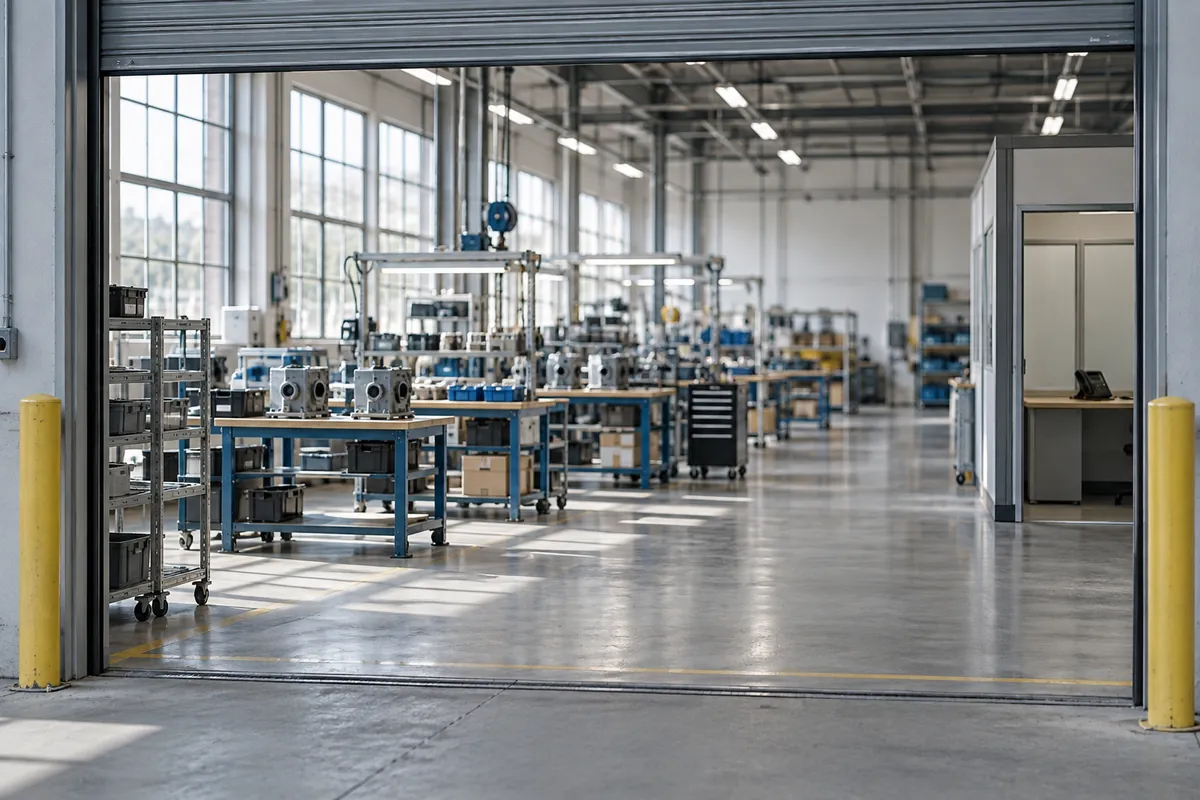
Buyers often treat "factory or trading company" as a trust question. It isn't. A trading company can be completely legitimate, well organized and reliable. What changes is not honesty, it's structure: who controls the production line, who adds a margin, and who you actually reach if something goes wrong mid-order.
In short: a factory owns and runs the production line that makes your product. A trading company sources it from one or several factories and manages the relationship, documentation and sometimes quality control on top. Neither is inherently better. The right choice depends on your order size, your industry, and how much of the process you want to manage yourself.
What each one actually does
A factory's core business is production. Its incentive is to keep the line running and the order specification stable, because changes cost it time and setup.
A trading company's core business is coordination. It may work with one factory it knows well, or shift between several depending on the product, the season, or the price a client needs. A good trading company adds real value here: supplier selection, quality oversight, consolidation of multiple product lines into one shipment, and a single point of contact instead of five factory relationships to manage separately.
Questions that reveal which one you're dealing with
Most suppliers will not volunteer this distinction unprompted, simply because from their side it rarely comes up. Ask directly:
- "Is this the factory that will produce my order, or do you work with a manufacturing partner?"
- "Can I see photos or video of the specific production line for my product?"
- "If I wanted to visit or send an inspector, which city would they go to?"
A trading company with nothing to hide answers these in a straightforward way. The answer to the third question, in particular, is hard to fake convincingly if the relationship isn't real.
When a trading company is the better choice
For a buyer sourcing across several product categories, in industries like furniture, lighting or packaging that each cluster in different regions of China, working through one coordinating partner instead of five separate factory relationships is often simpler and cheaper in practice, even with a margin built in. It also matters when a factory's minimum order doesn't match what you need, or when quality control across multiple production sites needs to be centralized under one process instead of repeated from scratch each time.
When going direct to the factory makes more sense
Direct-to-factory tends to pay off when the order is large, recurring and already specified in detail, and when the buyer has the internal capacity to manage production scheduling, quality control and logistics without an intermediary. It's a different operating model, not a universally better one.
Key takeaways
- Neither structure is a red flag on its own. The distinction is operational, not a trust signal.
- Ask which facility will physically produce your order, and whether you could send an inspector there.
- A trading company earns its margin through coordination, consolidation and a single point of contact across suppliers.
- Match the choice to your order profile: single large recurring order favors direct, multi-category sourcing favors coordination.
A group that already operates across multiple industries and manufacturing regions in China exists precisely to sit in that coordinating role, with production relationships already built rather than assembled order by order.